
REVIEW · SHORE EXCURSIONS
Guided Antwerp Port Tour, in your Car or Minibus
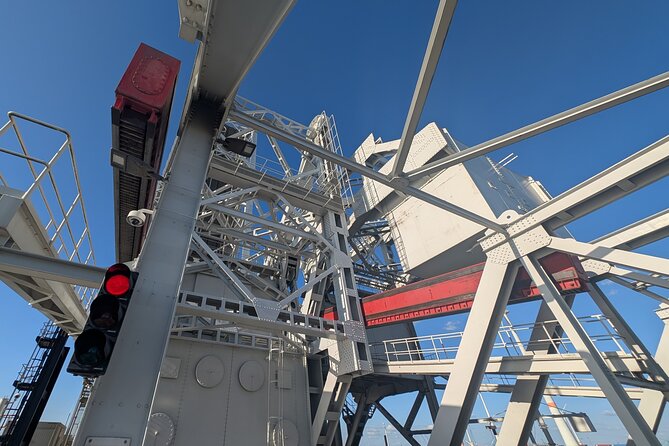
Port scale here is hard to picture until you drive it. This guided Antwerp Port Tour uses a car or minibus to show you how the city’s maritime machine actually runs, block by block, gate by gate.
I especially love two things: the chance to stand near Havenhuis Vantage at the Droogdokken, where Zaha Hadid’s modern form meets historic dry docks, and the way the route turns big industry into clear stories you can see from the road. One possible drawback is the focus on exterior views, so if you want deep museum time or hands-on access, this is more about watching and understanding than roaming inside.
Guides like Laurens and Niki are known for the same thing: they do not rattle off dates. They give context as you pass real infrastructure, and in Niki’s case, she has been described as handling Luxembourgish too, which is great if you have multilingual needs in your group.
In This Review
- Key highlights you will remember
- Port engineering by car, not by brochure
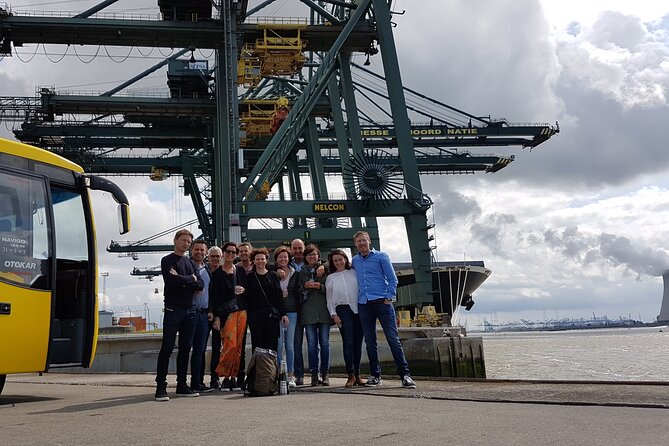
- Havenhuis Vantage and dry docks at Droogdokkenweg
- The Oosterweel contrast drive, medieval spire meets the biggest wharf
- Scheldelaan duality: petro-chem stacks, steam, and a graffiti wall
- Boudewijnsluis: locks that keep supplies moving
- Lillo drive-bys: ghost village traces in a changing port
- Berendrecht Lock and Dock 910: giants at the doorway
- Antwerp-North hump yard and the container canyon finale
- Price and value: $314.42 per group up to 15 people
- Who should book this, and who might prefer something else
- Practical tips so you enjoy it more
- Should you book Antwerp Port Tours?
- FAQ
- How long is the Guided Antwerp Port Tour?
- What is the price for the tour?
- Is this a private tour?
- What language is the tour offered in?
- Where is the meeting point, and where does it end?
- Do I need to bring a ticket?
- Do I need a car or minibus?
- What ages can participate?
- Is the tour suitable for people with respiratory problems?
- What happens if the weather is bad?
Key highlights you will remember
- Havenhuis Vantage at Droogdokkenweg, Zaha Hadid meets 19th-century dry dock basins
- Oosterweel contrast drive, a tiny medieval church beside Europe’s biggest wharf works
- Scheldelaan duality, chemical titans on one side, the graffiti wall on the other, plus pipeline talk
- Boudewijn and Van Cauwelaert locks, small by port standards, but essential for day and night supply
- Berendrecht Lock fly-by, big sea-lock engineering with a chance of seeing a massive vessel
- Lillo Fort and windmill remnants, human traces of port expansion, plus the feeling of scale
Port engineering by car, not by brochure
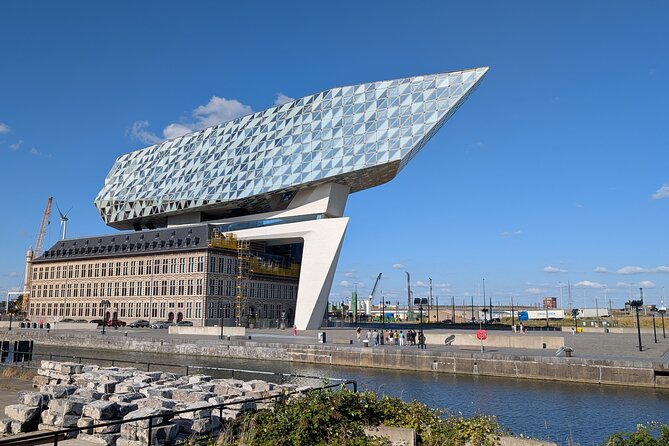
This is a guided Antwerp Port Tour by car or minibus, built for a 2 hours 30 minutes window. You start and end back at Kinepolis Antwerpen (Groenendaallaan 394, 2030 Antwerpen), and the guide boards your bus, so you can focus on the route instead of logistics.
The format matters. Antwerp’s port stretches so far that on foot you would see only a thin strip. From the vehicle, you get sweeping context fast, then a few short stops where you can actually look at details: the shapes of structures, the lock entrances, the container heights, and the industrial rhythm along the river.
Also, the company uses a mobile ticket, and gratuities are included. It is a private tour too, so it is just your group up to 15 people, which usually keeps questions flowing and avoids the awkward group herding you sometimes get on big shared buses.
A few more Antwerp outings worth a look
- Deluxe Bruges Shore Excursion from Zeebrugge Cruise Port
★ 4.5 · 80 reviews - Best Bruges Shore Excursion including Deluxe Canal Cruise
★ 4.0 · 27 reviews - 6 Hour Bruges Shore Excursion from Zeebrugge Cruise Port
★ 4.5 · 23 reviews
Havenhuis Vantage and dry docks at Droogdokkenweg
Your first meaningful moment lands at Droogdokkenweg, opposite Havenhuis Vantage, where diamond-glass architecture sits like it is floating on a 19th-century fire-station structure. Even if you are not a design nerd, you will quickly see why it grabs attention: the contrast between smooth modern glass and older heavy stone basins is striking.
You disembark briefly at a quiet pier and get a guided explanation of how Zaha Hadid’s design choices connect to the dry docks nearby. You are also looking at what is being transformed into the city’s maritime museum, so the stop works on two levels: it is a photo stop, but it also tees up the idea that the port is not frozen in time. It is being reused and reinterpreted.
Why this stop is worth it: it teaches you to read the port as an environment where old infrastructure gets a new purpose, not just an endless industrial zone.
What to watch for: if you are bringing a camera, position yourself before the guide starts explaining, because people tend to pause for photos and you may want one clean angle of the building plus the dock framing.
The Oosterweel contrast drive, medieval spire meets the biggest wharf
Next comes the drive-by that really makes the port feel real: Oosterweel Contrast Drive. You glide past a small 15th-century church, and right beside it you see the scale of the construction yard, where tunnel segments for Antwerp’s long-awaited Ring closure are being cast at what the guide describes as Europe’s biggest wharf works.
This is one of those moments where your brain has to reframe what you thought you knew about “a port.” The guide connects medieval river parishes and post-war port expansion to the infrastructure overhaul happening today. In other words, you do not just see industry, you see how decisions over centuries created the modern footprint.
Potential drawback: this is a drive-by segment, and some people only enjoy the visual impact if the light is right. If it is overcast, you can still learn a lot, but the yard details might not pop as much in photos.
Scheldelaan duality: petro-chem stacks, steam, and a graffiti wall
As your car rolls along Scheldelaan, the port turns into a moving storyboard. On the right side you get the petro-chemical side of Antwerp, with stainless tanks, towers, and visible steam. On the left, you get something that feels out of place in a port setting: a flood wall covered in color from an annual international graffiti contest.
Even if you do not care about street art, it helps you understand the port as a living boundary between work and community. And this is where the guide’s story-telling style really earns its keep. They point out how pipelines run under the roadway, like hidden arteries beneath the visible surface.
What you’ll get out of it: you will stop thinking of the port as separate compartments. You will see the connections, the systems that link refinery output, transport routes, and safety infrastructure.
Tip for you: bring a second pair of eyes for both sides of the car. People tend to focus on the louder chemical visuals, but the graffiti wall gives a useful counterpoint and makes the whole drive more memorable.
More things to do in Antwerp:
- Historical Walking Tour: Legends of Antwerp
★ 5.0 · 1,837 reviews - Antwerp: City Highlights Walking Tour
★ 4.7 · 816 reviews - Antwerp: City Highlights Guided Bike Tour
★ 4.7 · 529 reviews - Antwerp: Historical Walking Tour in the Old City
★ 4.8 · 373 reviews
Boudewijnsluis: locks that keep supplies moving
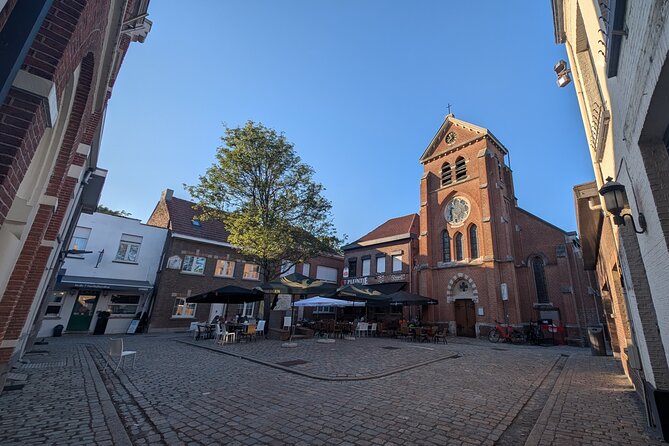
At Boudewijnsluis, you get the sort of port view that feels almost intimate. You step out near De Vaarkom basin with chemical stacks on one side and the twin Boudewijn and Van Cauwelaert locks on the other.
The locks are modest compared to the planet’s biggest sea structures, but that is exactly why they matter. They are vital “workhorse” gates for barges and short-sea feeder traffic, and they keep refinery supply lines moving day and night.
The guide explains what to look for: lock-master signals, bow thruster effects underfoot, and how tugs nudge freighters through the narrow sluices. If the timing lines up, you might see a vessel movement that gives the locks their full meaning, not just their size.
Why this stop works: you see how “small” port infrastructure drives the daily operation, not just the dramatic headline moments.
Lillo drive-bys: ghost village traces in a changing port
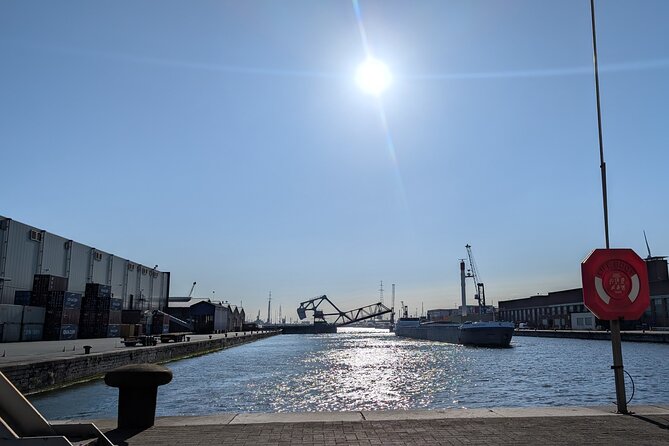
Later, you head to Lillo and the area around it. You first get a Lillo Windmill drive-by, where the solitary brick windmill remains, marking the vanished village of Lillo. The guide uses this lone survivor to explain the sheer sprawl of the port: by the time you pass 30 km already, you are only about halfway through its territory.
Then you slow down for Lillo Fort, and that is where the human scale comes in. You cross ancient roads and swap smokestacks for cobblestones. You might notice the geese on the ramparts, and you get glimpses of fishermen’s houses and a tiny dock that evoke life two centuries ago.
Even with chemical activity across the dike, this stop is about identity and continuity. The guide shares stories like Spanish sieges, smugglers, and the community that held onto itself while the port pushed inward.
What to expect: this portion feels less like an industrial tour and more like a quick time travel walk, with the added contrast that the port’s current presence is still in your peripheral vision.
Berendrecht Lock and Dock 910: giants at the doorway
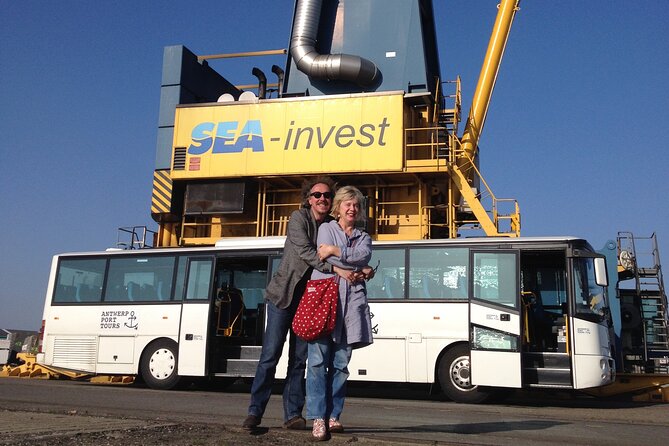
The tour then pushes back toward the dramatic engineering. The Berendrecht Lock fly-by is described as one of the world’s biggest sea locks and the main doorway to the docks beyond. When your car rolls along the service road and you see the lock opening beside you, you feel the choreography of tugboats and line-handlers in your mind even if you only catch a partial view of the process.
If a large bulker or container ship is passing, you may get a windshield-level sight of hull plates that dwarf typical city buildings. Even without a vessel moving at that exact moment, the scale and your guide’s framing make it a highlight.
You follow up with Dock 910 Riverside Overlook near PSA’s quays. From one vantage point, you can take in multiple layers at once: live container handling with straddle carriers, the Berendrecht and Zandvliet locks behind you, the Belgium-Netherlands border line mid-stream, and the Doel nuclear plant cooling towers in the distance.
Why this works for first-timers: it gives you a “control tower” mental map. You learn how the geography lines up, not just what each site is called.
Photo note: this is usually better for wide shots than close-ups. Container stacks and cooling towers give strong layers if you keep your horizon steady.
Antwerp-North hump yard and the container canyon finale
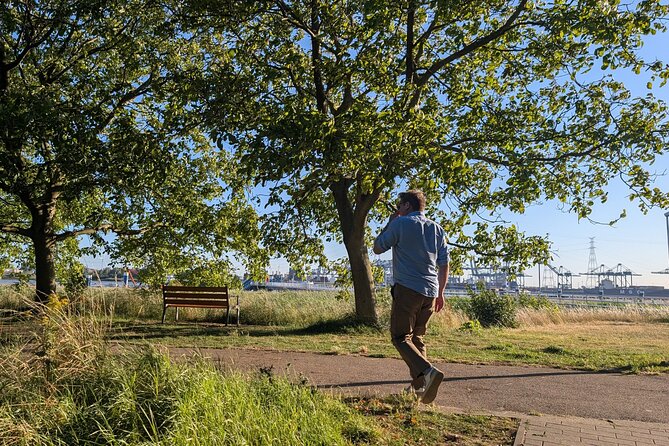
Not every part of the port is about ships. Two of the later stops teach you that the port runs on a road-rail-river mix.
At the Antwerp-North hump yard, you peer down on the marshalling yard, a spiderweb of tracks where up to a thousand wagons are reshuffled each day. The guide explains the process in plain terms: push mixed trains over the hump, let cars roll downhill, then use sensors and track retarders to brake each wagon into the right direction and set.
If the timing is right, you can watch the gravity-shunting ballet live. Even when you do not catch motion, the explanation makes the visible network feel like a system with a purpose.
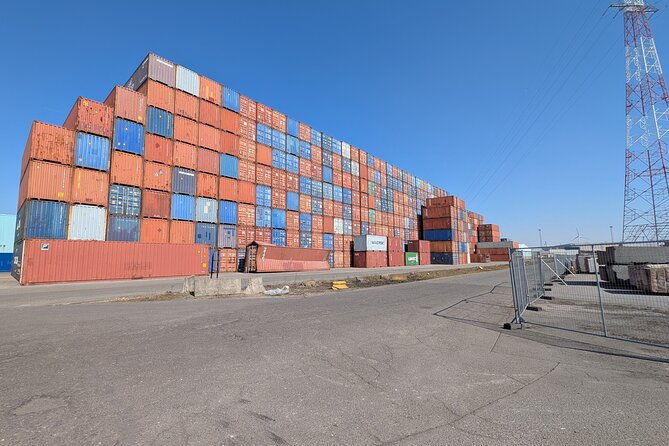
Then you end with Lillo or Lubeckweg style container canyon finale, where the road threads through multicolored container stacks like steel towers. On one side you see granite blocks waiting for export. On the other side you see refrigerated “reefer” racks around Europe’s largest fruit terminal, where bananas and citrus move from ship to supermarket at speed.
It is a strong ending because it hits two extremes: heavy industrial export and high-turn fresh produce. Both rely on the same transport infrastructure, and you leave with a clearer idea of how Antwerp serves very different supply chains.
Price and value: $314.42 per group up to 15 people
At $314.42 per group for up to 15 people, the pricing can feel surprisingly fair if you plan as a group. If you fill the maximum headcount, that works out to about $21 per person. If your group is smaller, your per-person cost goes up, but you still get a private, guided drive plus several curated stops that would be hard to stitch together on your own in a short time.
Two things make this good value for your money. First, the tour is timed for a 2 hours 30 minutes slot, which is enough to cover the main port zones without wasting your day chasing locations. Second, you get guided interpretation at key points like the locks and the dry docks, where names and design details matter.
And because admission tickets at the featured stops are listed as free during the experience, you are not hit with surprise entry fees on top of the tour cost.
Who should book this, and who might prefer something else
This tour fits best if you want your port visit to feel structured, not random. If you are visiting Antwerp for the first time and you want the port context that makes the city make sense, you will enjoy the route.
It is also a solid pick for families and mixed-age groups, since the pacing alternates between drive-by storytelling and short photo pauses. The tour is recommended for age 12 and up, and it says most travelers can participate.
One caution: it is not recommended for travelers with serious respiratory diseases. Because you are going near active industrial areas, I would treat that warning seriously and discuss it with your doctor if you have concerns.
Practical tips so you enjoy it more
- Wear shoes you are comfortable standing in for short pier and overlook moments.
- Bring a camera, because several stops are built for framing: Havenhuis Vantage plus the dry docks, the locks, and Dock 910.
- If weather is iffy, you still might go, but the experience requires good weather and may be rescheduled or refunded if it is canceled for poor conditions.
- Ask your guide questions. This type of tour works best when you treat it like a conversation, not a lecture.
Should you book Antwerp Port Tours?
I think you should book this tour if you want to understand Antwerp’s port as a working system, not just as a set of impressive photos. The route hits both the engineering highlights, like Berendrecht and the locks, and the quieter scale reminders, like the Lillo windmill and Lillo Fort.
Skip it only if you want a long indoor museum day or hands-on activities. This experience is built for viewing, learning from the road, and getting you oriented quickly to a place that otherwise feels too big to grasp.
If your group fits within the up-to-15 setup, it is also a nice way to share cost without losing privacy.
FAQ
How long is the Guided Antwerp Port Tour?
It runs about 2 hours 30 minutes.
What is the price for the tour?
The price is $314.42 per group, for groups up to 15 people.
Is this a private tour?
Yes. It is private, and only your group participates.
What language is the tour offered in?
It is offered in English.
Where is the meeting point, and where does it end?
The tour starts at Kinepolis Antwerpen, Groenendaallaan 394, 2030 Antwerpen, Belgium, and it ends back at the meeting point.
Do I need to bring a ticket?
You receive a mobile ticket.
Do I need a car or minibus?
You do not. The guide will board your car or minibus for the tour.
What ages can participate?
The advised minimum age is 12.
Is the tour suitable for people with respiratory problems?
It is not recommended for travelers with serious respiratory diseases.
What happens if the weather is bad?
The experience requires good weather. If it is canceled due to poor weather, you are offered a different date or a full refund.
The latest Antwerp write-ups
- Antwerp: Diamond & Jewish Quarter Walking Tour★ 4.5 · 5 reviews
- Antwerp: City Walk with Audio Guide in 7 Languages on your Phone★ 3.0 · 15 reviews
- Discover Antwerp while playing! Escape game – The alchemist★ 4.5 · 4 reviews
- Antwerp Private Custom Walking Tour With A Guide (Private Tour)★ 4.5 · 12 reviews
- Private MAS Antwerp Aperitif Cruise (13–50 Guests)★ 5.0 · 15 reviews
- Private Departure Transfer from Antwerp to Brussels By luxury car★ 3.5 · 3 reviews
- Landed On Time 60 min. Max 1 Person★ 4.0 · 5 reviews
- Private Authentic Indian Cooking Class in Antwerp with Aastha★ 5.0 · 3 reviews
Shore Excursions, compared.
Deluxe Bruges Shore Excursion from Zeebrugge Cruise Port
Read our review →
Best Bruges Shore Excursion including Deluxe Canal Cruise
Read our review →
6 Hour Bruges Shore Excursion from Zeebrugge Cruise Port
Read our review →
Best Bruges Shore Excursion from Your Ship with Canal Cruise
Read our review →
Private shore excursion from Zeebrugge to Bruges with driver and guide
Read our review →
Comprehensive Bruges Shore Excursion from Zeebrugge Cruise Port
Read our review →
Browse the lists this tour appears in